

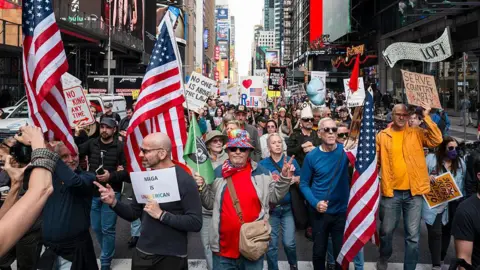
This weekend's 'No Kings' movement protests drew an estimated mass gathering across the US to demonstrate against President Donald Trump's agendas and his willingness to stretch the edges of White House control.
This served as a occasion for like-thinking liberal voters, left-leaning citizens and certain Republican dissenters to rally together at a period when the liberal faction has little governmental control in national politics.
However where do they go from here?
Huge Participation Outstrips Expectations
Based on observations, the turnout at the weekend's events - in prominent metropolitan areas like the Windy City, New York, Washington DC and Los Angeles, as well as countless lesser communities – was higher than expected and surpassed the initial 'No Kings' demonstration in June.
Republican legislators had warned that the protests would be unpatriotic, and some right-leaning executives had positioned their law enforcement and National Guard on readiness in case of conflict.
The enormous demonstrations were ultimately peaceful – a festival, not destruction. In Manhattan, there were no demonstration-linked arrests, and the convergence in the nation's capital showcased families and kids.
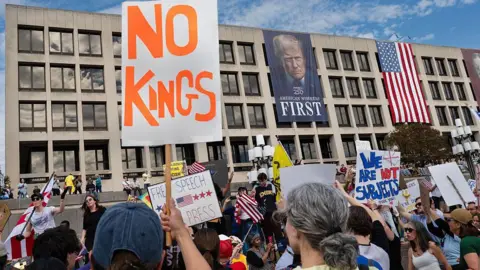
"Today nationwide in totals that may eclipse any prior instance of demonstration in our country's past, Americans are declaring clearly and confidently that we are a independent citizens, we are cannot be a population that can be ruled, our leadership is not for sale," an influential lawmaker declared in his speech to the Washington DC demonstration.
White House Answer and Governmental Consequences
In close proximity from the anti-monarchy gathering in the federal district, the White House reacted to the protests with disdain.
"Why bother," a deputy press secretary wrote in reply to various media inquiries about the protests.
the commander-in-chief distributed multiple AI-generated videos on his digital channel of him displaying a crown, featuring one where he was operating a plane that released what seemed to be human waste on the protesters.
Even though conservative lawmakers may be diminishing the impact of the demonstrations, the scale of the turnout – combined with the administration's net negative approval rating in leading opinion polls - hints at a Democratic chance to bounce back from recent electoral defeats.
Democratic Obstacles and Factional Disagreements
The Democratic organization still has a considerable distance to make progress, though.
Surveys suggest just a one-third of Americans approve of it - the weakest for a generation - and Democratic leaders are disagreeing over ways to mount an effective opposition to Trump when they no longer control both houses of the legislature.
Progressive activists took to the streets on the weekend for a variety of reasons. The president's assertive immigration enforcement, his import taxes, his spending reductions, his foreign policy, his use of military reserves in American urban centers and his precedent-challenging use of executive power were every one common themes of anxiety and anger.
Certain elements of the discontent was additionally directed at party leadership.
"We are simply suffering losses, and we're remaining silent," one demonstrator in the capital told press agencies on the weekend. "Realize, I think we must throw some more elbows. Unfortunately, the moral approach doesn't work."
Budget Impasse Approach and Political Perils
The Democrats have been more aggressive over the continuing federal closure, which is approaching its month-long duration. They have been unwilling to approve a short-term continuation of present government funding without a compromise solution to tackle health-insurance subsidies for low-income Americans scheduled to end at the conclusion of December.
Owing to congressional protocols, liberal lawmakers have some power despite being in the weaker position – and, up to now, the general population seems to be attributing equal if not more blame for the stalemate to the president and the GOP leadership.
However the strategy involves dangers too. The pain from the closure – especially for members of the liberal base – is set to worsen as the time progress.
Numerous government employees have not received salaries and are facing monetary struggle. Financial support is projected to end for low-income food support. The US judicial system is reducing its functions. And the Trump administration is employing the shutdown to order further decreases to the federal workforce and halt domestic spending, targeting blue territories and cities.
Forthcoming Votes and Partisan Outlook
The reality is that liberal officials in the upper chamber will eventually have to discover a solution of the emergency. But they may be struggling to reach agreements that the demonstrators who took to the streets on Saturday will find acceptable.
"If|In case|


